


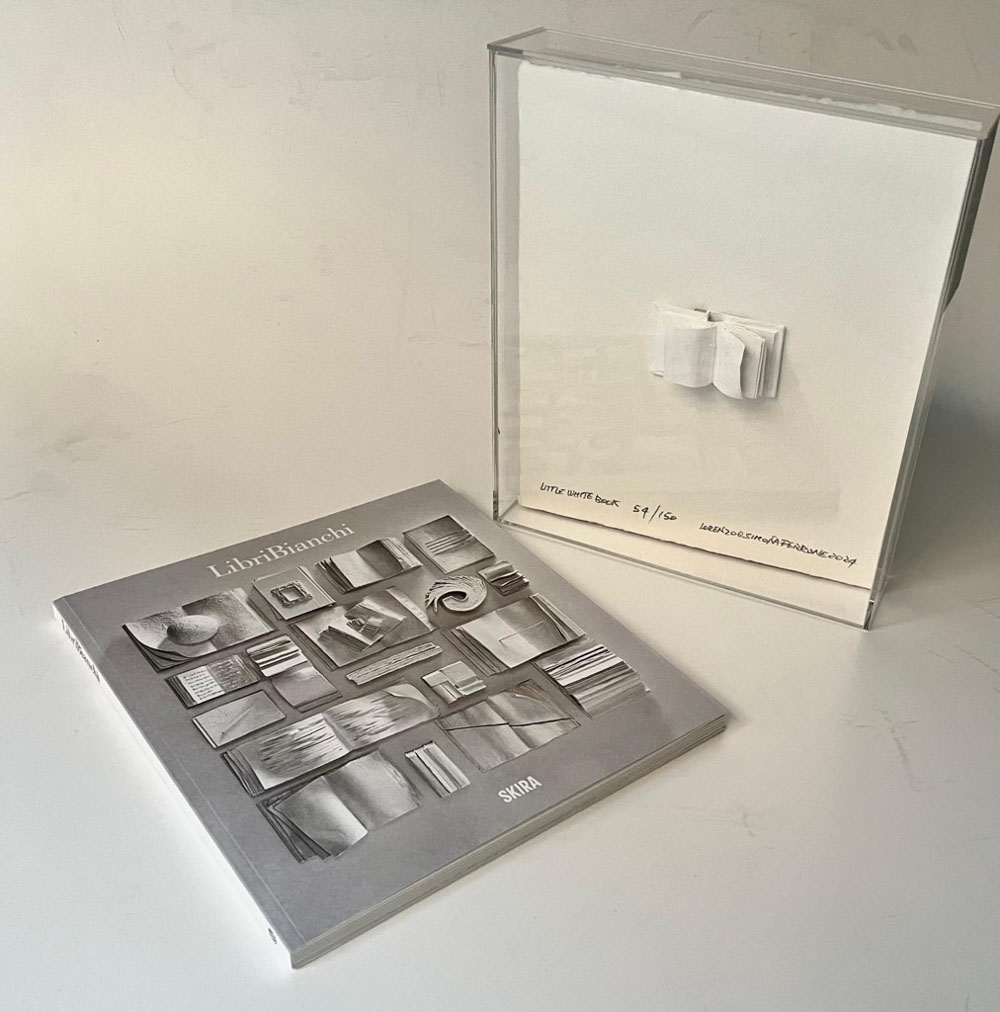
Little white book by Lorenzo e Simona Perrone
Little White Book appears as a quiet, essential object, transformed into sculpture through the Perrones’ distinctive process. The book, coated in white and stripped of its original function, becomes a pure symbol—an archetype of knowledge. Its textured surface, created with plaster, glue, and water, gives the volume a suspended, almost ritual presence. In this distilled form, Little White Book invites the viewer to reflect on the value of knowledge and the fragility of culture today.
The artists: Lorenzo e Simona Perrone
For over twenty years, Lorenzo and Simona Perrone have developed their LibriBianchi, exploring the book as a cultural object and as a symbol of civilization. Their artistic language starts from real books, transformed through material interventions and the addition of external elements. The result is an artwork that transcends the object’s original purpose and becomes sculpture, memory, and testimony.
Lorenzo (Milan, 1944) comes from a long career in publishing and communication, combined with a lifelong passion for painting and sculpture. Simona (Florence, 1958) has a background in fashion, costume, and photography, before turning to art through her collaboration with Lorenzo. They live and work in Milan.
Description
In Little White Book, the book appears as a fragment of suspended time. The white surface both erases and amplifies it. What remains is an object rich with meaning—essential and poetic. The material reveals hints of folds, textures, and imperfections, reminding us that every book holds stories, even when it is no longer meant to be read. The sculpture becomes a meditation on knowledge, memory, and the need to safeguard culture.
Conclusion
Little White Book communicates with both simplicity and strength. A real book becomes a universal symbol, capable of evoking reflections on knowledge and its transformation. Through their minimal yet powerful intervention, the Perrones invite us to see the book not only as an object, but as an idea—an essential element of our cultural identity.